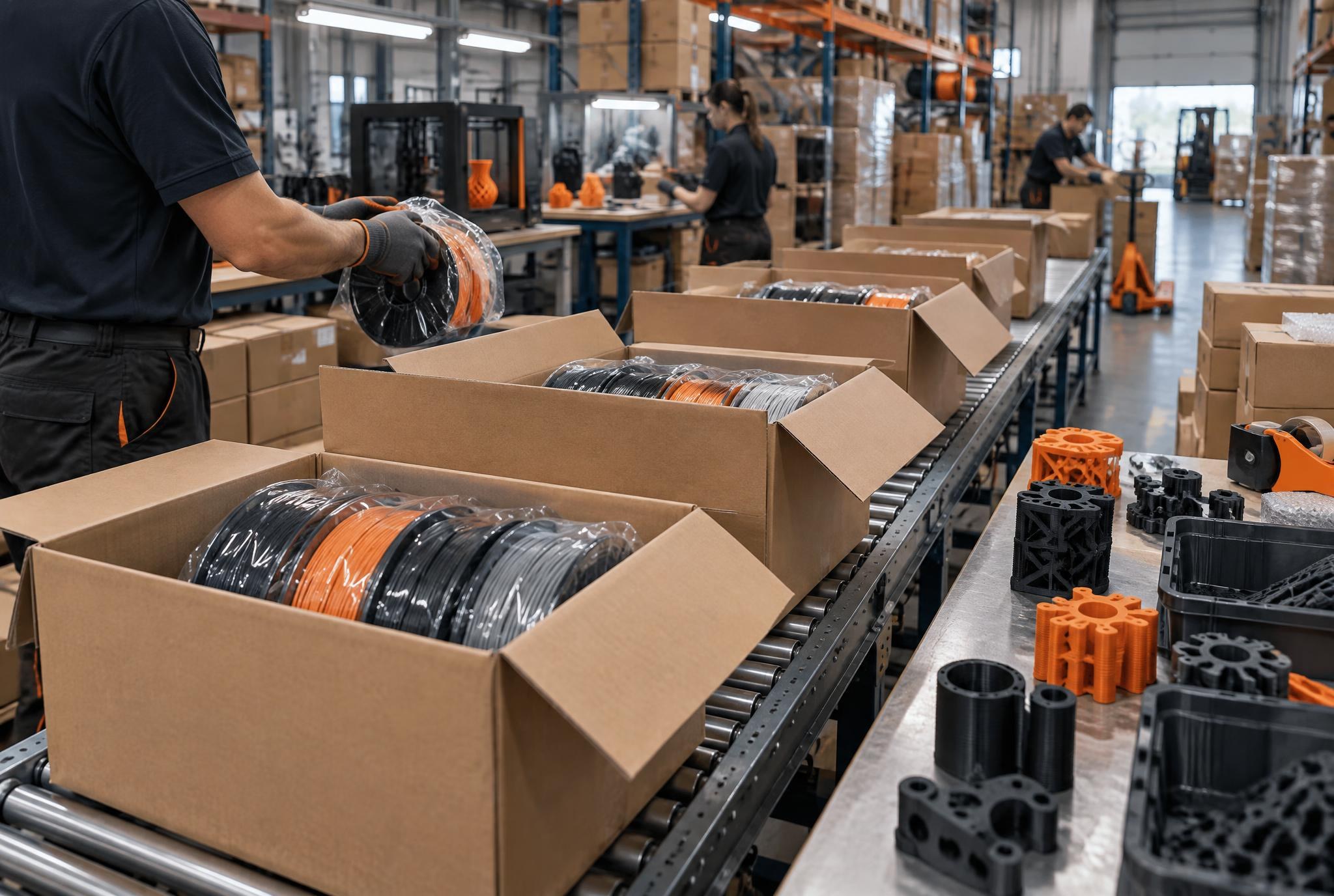
One Shipment
Multiple SKUs, one container
A print farm running six colours across three machines types does not need six separate shipments — consolidation at the loading point is what keeps freight cost per spool down.
When filament is your largest recurring input and your machines run unattended overnight, the cost of a bad batch is not the material — it is the print hours it destroys.
One Shipment
A print farm running six colours across three machines types does not need six separate shipments — consolidation at the loading point is what keeps freight cost per spool down.
Farm operators are routinely quoted on price per kilogram, then discover the number that matters is somewhere else entirely.
| What gets quoted | What actually determines cost | Why the gap matters |
|---|---|---|
| Price per kg | Cost per successful part | A 10% price saving is erased by a 3–4% increase in failure rate on most part geometries |
| Spool weight | Changeover events per production week | Every changeover is operator time plus a purge; 5kg spools cut the count by roughly 80% versus 1kg |
| Colour range available | Colours actually held in depth | Farms standardise on few colours; breadth is a retail concern, depth is a production one |
| Lead time on paper | Variance in lead time | A reliable 30 days beats an unpredictable 12 — you can plan around the former |
| Nominal tolerance | Whether it is measured and reported | An advertised tolerance is a claim; a per-lot report is evidence |
Ordered by how much damage they do per occurrence, not by how often they happen.
A crossed wrap on the spool jams the feed mid-print. If it happens at 02:00 on a 14-hour job, you lose the job and the overnight slot. This is the single most expensive filament defect in production because the damage scales with how long nobody was watching.
Root cause: poor mechanical winding at the factory — the filament crosses over itself and pinches under tension. Not something you can fix downstream.
A new box behaves differently from the last one — flow is slightly off, adhesion changes, a profile that has run for months starts producing marginal parts. The failure is insidious because the parts are not obviously bad, they are just out of tolerance often enough to hurt.
Root cause: the supplier changed the production line, the masterbatch, or the base resin lot without telling anyone. Often the supplier does not consider this a change worth communicating.
Bubbling, popping during extrusion, hairy surfaces, parts that snap along layer lines. On PETG, PA and TPU this is the most common quality complaint, and the material is frequently blamed when the real cause is a failed vacuum seal in transit or an open shelf in a humid workshop.
Root cause: hygroscopic polymer plus inadequate packaging plus ambient humidity. All three are manageable; usually none of them are managed.
The customer ordered 400 units. You printed 250 from the old batch and 150 from the new one, and the greys do not match. This is not a tolerance problem, it is a visible defect to the end customer, and it usually surfaces after shipping.
Root cause: pigment lot variation, or a masterbatch supplier change upstream of your filament supplier — two levels away from anyone you talk to.
Nominal 1.75mm filament that wanders to 1.79mm over-extrudes; ovality causes inconsistent flow as the spool rotates. On cosmetic parts you see it as surface inconsistency; on dimensional parts it fails inspection.
Root cause: extrusion line control and, on filled grades, uneven filler distribution.
Carbon- and glass-filled filament abrades brass nozzles within a few kilograms. The nozzle bore opens gradually, so quality degrades slowly rather than failing outright — which means it is usually caught late.
Root cause: running abrasive material through non-hardened nozzles. Entirely preventable, routinely overlooked when a farm adds a reinforced grade to an existing fleet.
Your supplier reallocates capacity, raises prices mid-relationship, or simply goes quiet. At production scale you cannot absorb a two-week gap, and buying retail to bridge it destroys the margin on whatever you are printing.
Root cause: single-supplier dependency on a high-volume, low-differentiation input.
Not a defect, but at scale it is a real line item. Every spool change is a walk to the machine, a purge, and a short interruption. Across dozens of machines running continuously, that adds up to a meaningful fraction of an operator's week.
Root cause: buying the format that suits hobby printing rather than production.
If you take nothing else from this page, put these eight lines in your next enquiry.
| # | Specify | Prevents |
|---|---|---|
| 1 | Mechanically wound spools + unwind test on first sample | Tangling on unattended prints |
| 2 | Production line locked to SKU, with written change notification | Silent batch drift |
| 3 | Lot marking on every spool label | Untraceable complaints |
| 4 | Per-lot measurement report — diameter and ovality | Extrusion inconsistency |
| 5 | Vacuum + desiccant packaging as standard | Moisture defects |
| 6 | Retained reference sample for colour-critical SKUs | Colour shift between restocks |
| 7 | 3kg / 5kg format for top-volume colours | Changeover labour |
| 8 | Qualified second source per high-volume SKU | Supply interruption |
A starting point for a farm running mixed commercial work. Adjust to your actual product mix.
| Item | Typical specification | Rationale |
|---|---|---|
| Primary material | PLA and PETG, 1.75mm, 3kg or 5kg spools | Covers most commercial FDM work; large format cuts changeover |
| Colour depth | 5–8 colours held deep, rather than 30 held thin | Production standardises; retail diversifies |
| Secondary materials | ABS / ASA / TPU as the product mix requires | Quoted on the same request, shipped in the same container |
| Reinforced grades | Only if the fleet has hardened nozzles | Otherwise you are buying a nozzle-wear problem |
| Consumable parts | Nozzles, build plates, PTFE tubing — bundled | Wear items; separate orders mean separate freight |
| Packaging | Vacuum + desiccant, cartons palletised | Essential for PETG and TPU |
| Documentation | Per-lot report | Lets you correlate a bad production run to a specific lot |
| Sourcing | Primary + qualified secondary per high-volume SKU | Single-source dependency is the biggest structural risk |
Because changing means re-validating profiles across the fleet, and that work happens during production time. The switching cost is real and it is usually larger than the price difference being offered. Any supplier who pretends otherwise has not run a farm.
Not a lower price. A measurably lower failure rate, a format that cuts labour, documentation you currently cannot get, or removing a single-source risk. If none of those apply, staying put is the rational choice.
Use 3kg or 5kg spools for your highest-volume colours and 1kg for everything else. Large formats cut changeover labour roughly in proportion to their weight ratio, but they tie up more cash per SKU and sit open longer — which matters for hygroscopic materials. Check spool holder clearance and enclosure dimensions before committing, since not every machine accepts a 5kg spool.
Tangling originates at the factory winding stage, not in your workshop. Specify mechanically wound spools, run an unwind test on the first sample from any new supplier by pulling two hundred metres off by hand, and reject suppliers whose samples snag. No spool holder modification reliably fixes badly wound filament.
Because something changed upstream — the production line, the masterbatch, or the base resin lot — and the supplier did not consider it worth mentioning. Prevent it by locking the production line to the SKU, requiring lot marking on every spool, and making written change notification a condition of the order. Changes will still happen; the point is that they stop being surprises.
Only if the failure rate is equal. Take your machine's hourly output value, multiply by average hours lost per failed print, then by your failure rate — that figure is typically larger than the entire price spread between the cheapest and most expensive filament on a shortlist. Cost per successful part is the number that matters.
Not without fitting hardened steel nozzles first. Carbon and glass filled grades abrade brass nozzles within a few kilograms, and the resulting bore wear degrades quality gradually rather than failing visibly — so it tends to be caught late, after a lot of marginal parts have shipped.
At least two per high-volume SKU, with the second qualified before you need it. Qualification during an outage is worthless because you have no time to validate. The cost of running a small periodic batch from a secondary supplier is minor compared with emergency retail purchasing or idle machines.
Last reviewed . Market figures from a survey of 41 supplier storefronts conducted July 2026.